K562 Perturbation
For preprocessing the CRISPR screen with scATAC-seq data, we use the pipeline provided by the data author: Pipeline
Pierce, S. E., Granja, J. M. & Greenleaf, W. J. High-throughput single-cell chromatin accessibility CRISPR screens enable unbiased identification of regulatory networks in cancer. Nat Commun 12, 2969 (2021). 10.1038/s41467-021-23213-w
To initiate the preprocessing, we first retrieve the sequencing data as listed in the following table:
Once the required files are obtained, we can modify the pipeline to process the data, certain steps require extra functions defined in a separate R file provided by the data author:
###########################################
# Analysis of Spear-ATAC-Screens
###########################################
library(ArchR)
library(Matrix)
library(Biostrings)
library(edgeR)

addArchRGenome("hg38")
addArchRThreads(20)

#Make Sure Data is present
source("Scripts/Download-Test-SpearATAC-Data.R")

#Helpful functions designed for SpearATAC Analysis
source("../scPerturb/Scripts/SpearATAC-Functions.R")

#Input Fragments
#Note we had 6 replicates for K562 but we will show 2 here for simplicity
inputFiles <- c(
  "K562_R1"="./K562/K562-LargeScreen-R1.fragments.tsv.gz",
  "K562_R2"="./K562/K562-LargeScreen-R2.fragments.tsv.gz",
  "K562_R3"="./K562/K562-LargeScreen-R3.fragments.tsv.gz",
  "K562_R4"="./K562/K562-LargeScreen-R4.fragments.tsv.gz",
  "K562_R4"="./K562/K562-LargeScreen-R5.fragments.tsv.gz",
  "K562_R4"="./K562/K562-LargeScreen-R6.fragments.tsv.gz"
)

#Get Valid Barcodes
validBC <- getValidBarcodes(
  csvFiles = c("./K562/K562-LargeScreen-R1.singlecell.csv", "./K562/K562-LargeScreen-R2.singlecell.csv",
               "./K562/K562-LargeScreen-R3.singlecell.csv", "./K562/K562-LargeScreen-R4.singlecell.csv",
               "./K562/K562-LargeScreen-R5.singlecell.csv", "./K562/K562-LargeScreen-R6.singlecell.csv"),
  sampleNames = c("K562_R1", "K562_R2", "K562_R3", "K562_R4","K562_R5", "K562_R6")
)

#Get sgRNA Assignments Files that names match the sample names in the ArchRProject
#Files were created from JJJ.R
sgRNAFiles <- c("K562_R1"="./K562/K562-LargeScreen-R1.sgRNA.rds", "K562_R2"="./K562/K562-LargeScreen-R2.sgRNA.rds",
                "K562_R3"="./K562/K562-LargeScreen-R3.sgRNA.rds", "K562_R4"="./K562/K562-LargeScreen-R4.sgRNA.rds",
                "K562_R5"="./K562/K562-LargeScreen-R5.sgRNA.rds", "K562_R6"="./K562/K562-LargeScreen-R6.sgRNA.rds")

#Create Arrow Files
ArrowFiles <- createArrowFiles(inputFiles=inputFiles, validBarcodes = validBC)
ArrowFiles

#Make an ArchR Project
proj <- ArchRProject(ArrowFiles, outputDirectory = "K562_LS")

#Create an sgRNA assignment matrix
#Iterate over each sgRNA aligned file
createSpMat <- function(i,j){
  ui <- unique(i)
  uj <- unique(j)
  m <- Matrix::sparseMatrix(
    i = match(i, ui),
    j = match(j, uj),
    x = rep(1, length(i)),
    dims = c(length(ui), length(uj))
  )
  rownames(m) <- ui
  colnames(m) <- uj
  m
}

sgAssign <- lapply(seq_along(sgRNAFiles), function(x){

  message(x)

  #Read in sgRNA Data Frame
  sgDF <- readRDS(sgRNAFiles[x])

  #Create sparseMatrix of sgRNA assignments
  sgMat <- createSpMat(sgDF[,1], sgDF[,2])

  #Create Column Names that match EXACTLY with those in the ArchR Project
  #Cell barcodes in our case were the reverse complement to thos in the scATAC-seq data
  colnames(sgMat) <- paste0(names(sgRNAFiles)[x],"#", reverseComplement(DNAStringSet(colnames(sgMat))),"-1")

  #Check This
  if(sum(colnames(sgMat) %in% proj$cellNames) < 2){
    stop("x=",x,"; Error matching of sgRNA cell barcodes and scATAC-seq cell barcodes was unsuccessful. Please check your input!")
  }

  #Filter those that are in the ArchR Project
  sgMat <- sgMat[,colnames(sgMat) %in% proj$cellNames,drop=FALSE]

  #Compute sgRNA Staistics
  df <- DataFrame(
    cell = colnames(sgMat), #Cell ID
    sgAssign = rownames(sgMat)[apply(sgMat, 2, which.max)], #Maximum sgRNA counts Assignment
    sgCounts =  apply(sgMat, 2, max), #Number of sgRNA counts for max Assignment
    sgTotal = Matrix::colSums(sgMat), #Number of total sgRNA counts across all Assignments
    sgSpec = apply(sgMat, 2, max) / Matrix::colSums(sgMat) #Specificity of sgRNA assignment
  )

  #Return this dataframe
  df

}) %>% Reduce("rbind", .)

sgAssign

#Make the rownames the cell barcodes
rownames(sgAssign) <- sgAssign[,1]

#Plot Cutoffs of sgRNA Assignment (NOTE: You may want to adjust these cutoffs based on your results!)
nSg <- 20
Spec <- 0.8
p <- ggPoint(log10(sgAssign$sgCounts), sgAssign$sgSpec, colorDensity = TRUE) +
  geom_vline(xintercept = log10(nSg), lty = "dashed") +
  geom_hline(yintercept = Spec, lty = "dashed") +
  xlab("log10(sgCounts)") + ylab("Specificity")
plotPDF(p, name = "Plot-Assignment-Density", addDOC = FALSE, width = 5, height = 5)

#Add all this information to your ArchRProject
proj <- addCellColData(proj, data = sgAssign$sgAssign, name = "sgAssign", cells = rownames(sgAssign), force = TRUE)
proj <- addCellColData(proj, data = sgAssign$sgCounts, name = "sgCounts", cells = rownames(sgAssign), force = TRUE)
proj <- addCellColData(proj, data = sgAssign$sgTotal, name = "sgTotal", cells = rownames(sgAssign), force = TRUE)
proj <- addCellColData(proj, data = sgAssign$sgSpec, name = "sgSpec", cells = rownames(sgAssign), force = TRUE)

#Identify those sgRNA Assignemnets that passed your cutoffs
proj$sgAssign2 <- NA
proj$sgAssign2[which(proj$sgCounts > nSg & proj$sgSpec > Spec)] <- proj$sgAssign[which(proj$sgCounts > nSg & proj$sgSpec > Spec)]
proj$sgAssign3 <- stringr::str_split(proj$sgAssign2,pattern="\\-",simplify=TRUE)[,1]

#Print Numbers
table(proj$sgAssignFinal)
#sgARID2  sgARID3A    sgATF1    sgATF3  sgBCLAF1    sgBRF2     sgCAD   sgCDC5L   sgCEBPB   sgCEBPZ    sgCTCF    sgCUX1    sgELF1
#    336       201       397       182       351       359       186       247       341       399       258       352       399
#sgFOSL1   sgGABPA   sgGATA1   sgGTF2B   sgHINFP   sgHSPA5    sgKLF1   sgKLF16     sgMAX     sgMYC    sgNFE2    sgNFYB    sgNRF1
#    402       282       223       197       339       262       219       231       269       196       341       356       305
#sgPBX2  sgPOLR1D    sgREST    sgRPL9  sgSETDB1    sgsgNT     sgTBP   sgTFDP1   sgTHAP1  sgTRIM28     sgYY1  sgZBTB11 sgZNF280A
#   366       311       349       247       393      1616       349       350       244       360       288       363       393
#sgZNF407    sgZZZ3       UNK
#     373       338     18861


#########################################################################
#We suggest saving your progress at this moment
#########################################################################
saveRDS(proj, "Save-ArchRProject-W-sgRNA-Assignments-1.rds")

sgRNA<-getCellColData(proj,"sgAssign3")
groupList <- SimpleList(split(rownames(sgRNA), paste0(sgRNA[,1])))

sgRNA$sgAssign3

uniqSg <- unique(sgRNA[,1])
uniqSg <- uniqSg[!is.na(uniqSg)]
uniqSg <- uniqSg[uniqSg %ni% nonTarget]

uniqSg

groupList
#We now want to clean our sgAssignments based on the homogeneity of the sgRNA signal. This analysis shouldnt filter more than 5-10%
#of sgRNA assignments. This will help resolve your differential analyses but is not crucial for downstream analysis.
proj <- cleanSgRNA(ArchRProj = proj, groupSg = "sgAssign3", individualSg = "sgAssign2", nonTarget = "sgsgNT")
proj$sgAssignFinal <- "UNK"
proj$sgAssignFinal[proj$PurityRatio >= 0.9] <- proj$sgAssign3[proj$PurityRatio >= 0.9]
proj$sgIndividual <- ifelse(proj$sgAssignFinal=="UNK", "UNK", proj$sgAssign2)

#Lets create an unbiased LSI-UMAP to sgRNA assignments by creating an iterativeLSI reduction + UMAP
proj <- addIterativeLSI(proj)
proj <- addUMAP(proj,force=TRUE)


#Create Color Palettes
pal4 <- paletteDiscrete(paste0(unique(proj$Sample)))

pal1 <- paletteDiscrete(paste0(unique(proj$sgAssign2)))
pal1["NA"] <- "lightgrey"

pal2 <- paletteDiscrete(paste0(unique(proj$sgAssign3)))
pal2["NA"] <- "lightgrey"

pal3 <- paletteDiscrete(paste0(unique(proj$sgAssignFinal)))
pal3["UNK"] <- "lightgrey"

pal3

#Plot UMAP Embeddings
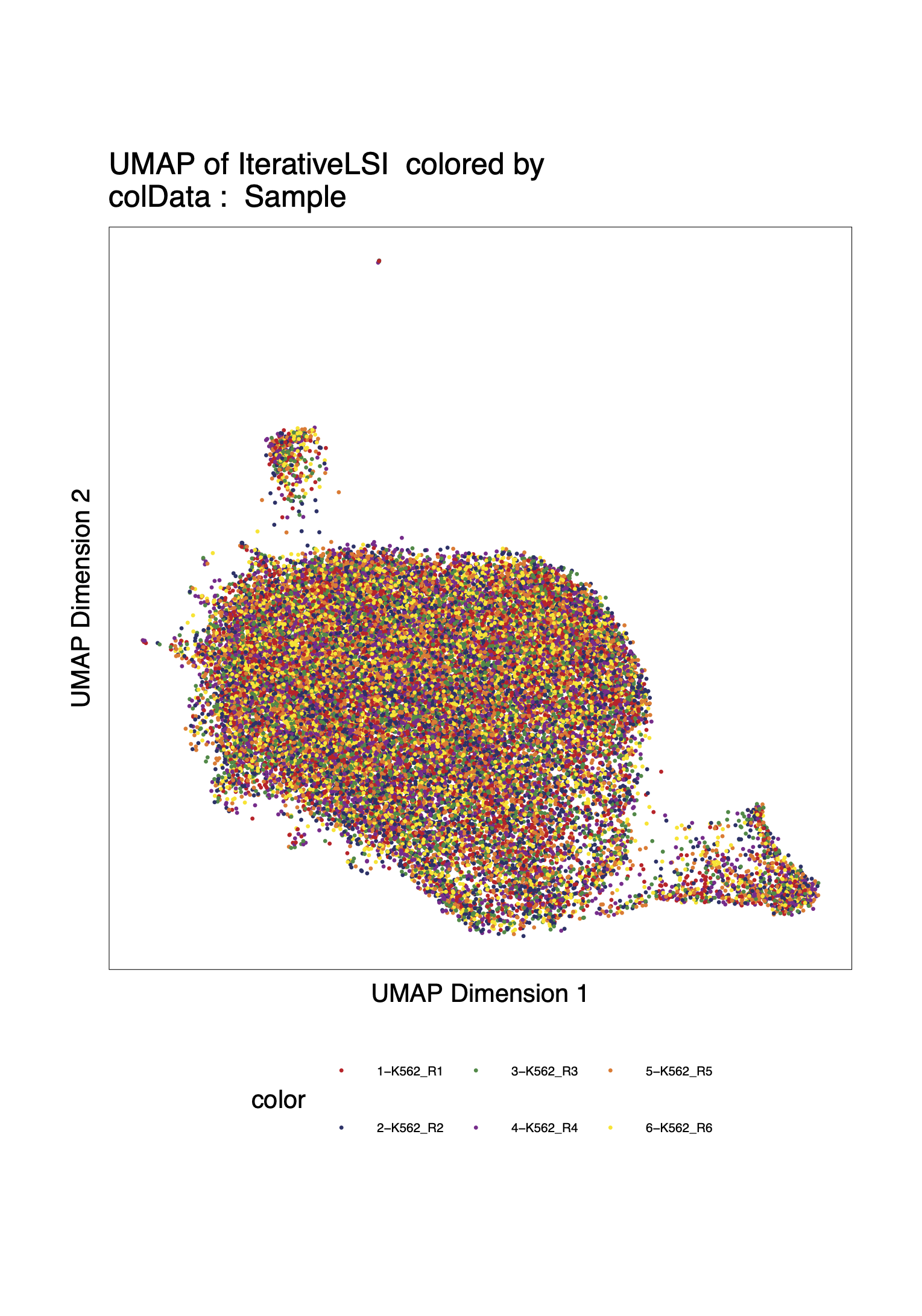
p1 <- plotEmbedding(proj, colorBy = "cellColData", name = "Sample", pal=pal4,labelMeans = FALSE)
p2 <- plotEmbedding(proj, colorBy = "cellColData", name = "sgAssignFinal", pal = pal3, labelMeans = FALSE)

ggsave(
  "./Plots/K562_UMAP_p1.pdf", p1,
  scale = 1,
  width = 8,
  height = 8,
  dpi = 600)

ggsave(
  "./Plots/K562_UMAP_p2.pdf", p2,
  scale = 1,
  width = 8,
  height = 8,
  dpi = 600)

#Call Peaks using sgAssignments
proj <- addGroupCoverages(proj, groupBy = "sgAssignFinal")
saveRDS(proj, "Save-ArchRProject-W-sgRNA-Assignments-2.rds")
proj <- addReproduciblePeakSet(proj,
                               groupBy = "sgAssignFinal",
                               pathToMacs2 = "/Users/zeyulu/anaconda3/bin/macs2")

proj <- addPeakMatrix(proj)

#Filter These sgRNA non-targetting because they seem to exhibit some differences from the other sgNT
#This step helps a bit, but is not necessary to get differential results
bgd <- grep("sgNT", proj$sgIndividual, value=TRUE) %>% unique

bgd
bgd <- bgd[!grepl("-11|-12|-8|-5|-6", bgd)]
proj$sgAssignClean <- proj$sgAssignFinal
proj$sgAssignClean[grepl("-11|-12|-8|-5|-6", proj$sgIndividual)] <- "UNK"

#Sort sgRNA Targets so Results are in alphabetical order
useGroups <- sort(unique(proj$sgAssignClean)[unique(proj$sgAssignClean) %ni% c("UNK")])
bgdGroups <- unique(grep("sgNT", proj$sgAssignClean,value=TRUE))

useGroups
bgdGroups
proj
#Differential Peaks
diffPeaks <- getMarkerFeatures(
  ArchRProj = proj,
  testMethod = "binomial",
  binarize = TRUE,
  useMatrix = "PeakMatrix",
  useGroups = useGroups,
  bgdGroups = bgdGroups,
  groupBy = "sgAssignClean",
  bufferRatio = 0.95,
  maxCells = 250,
  threads = 10
)
dir.create("./K562/MarkerSet/", showWarnings = FALSE, recursive = TRUE)
markerLists<-getMarkers(DiffPeaks,cutOff = "FDR <= 0.05 & abs(Log2FC) >= 2")
unique_TF_names<-names(markerLists)
unique_TF_names
for(i in 1:length(markerLists)){
  if(nrow(markerLists[[i]])>0){
    gr<-GRanges(
      seqnames = as.character(markerLists[[unique_TF_names[i]]]$seqnames),
      ranges = IRanges(start = markerLists[[unique_TF_names[i]]]$start, end = markerLists[[unique_TF_names[i]]]$end),
      strand = "*",
      score = abs(markerLists[[unique_TF_names[i]]]$Log2FC))
    export.bed(gr,paste0("./K562/MarkerSet/",unique_TF_names[i],".bed"))
  }
}
We can generate the UMAP plots colored by sample replicates or sgRNA target.
By sample replicate:
By sgRNA target:
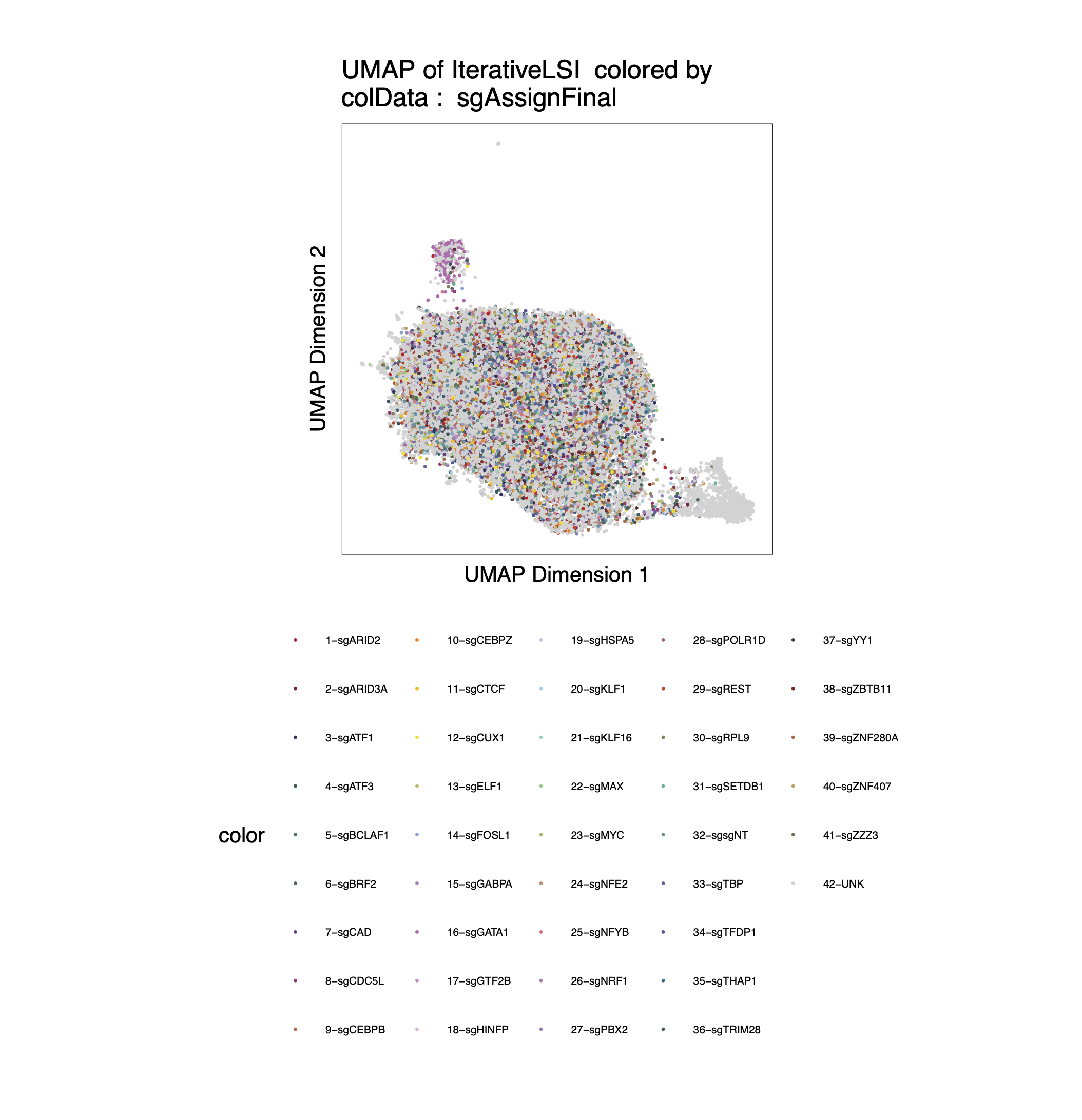
After processing, we obtain *.bed files for each sgRNA target.

Next we apply BIT to all datasets to generate the ranks:
Noticed in plot 1 and in the original publication, the sgGATA1 targeted cells are more significantly differ from the rest cells. We show the top10 TRs ranked by BIT in the sgGATA1 targeted cells:
data_read<-read.csv(paste0("./K562/bit/sgGATA1_rank_table.csv"))
data<-data.frame(Group="sgGATA1 targeted cells",
                 Label=data_read[1:20,"TR"],
                 Value=data_read[1:20,"BIT_score"],
                 Upper=data_read[1:20,"BIT_score_upper"],
                 Lower=data_read[1:20,"BIT_score_lower"])
data$Label<-factor(data$Label,levels=rev(data$Label))
top10_data <- data[1:10, ]

p1<-ggplot(top10_data, aes(x = Label, y = Value)) +
  geom_col(fill="#BADDF5",colour="black",size=0.25) +
  geom_errorbar(aes(ymin = Lower, ymax = Upper), width = 0.5, color = "black", size = 0.35) +
  coord_flip() +  # Flip coordinates to make the bar plot horizontal
  facet_grid(.~Group, scales = "free_y") +  # Facet by group, allowing free scales on the y-axis
  labs(title = "",
       x = "Top 10 Identified TRs",
       y = "") + scale_y_continuous(limits=c(0,0.05),breaks=seq(0,0.5,by=0.01),expand = c(0,0)) +
  theme_bw() +  # Using a minimal theme
  theme(axis.text.x = element_text(color="black",size=12),
        axis.text.y = element_text(color="black",size=12),axis.title.y=element_text(size=14),
        legend.position = "none", plot.margin = unit(c(0,0.5,0,0),"cm")) +theme(strip.background = element_rect(fill="#DBD1B6"),
                                                                                strip.text = element_text(size=12, colour="black"))
p1
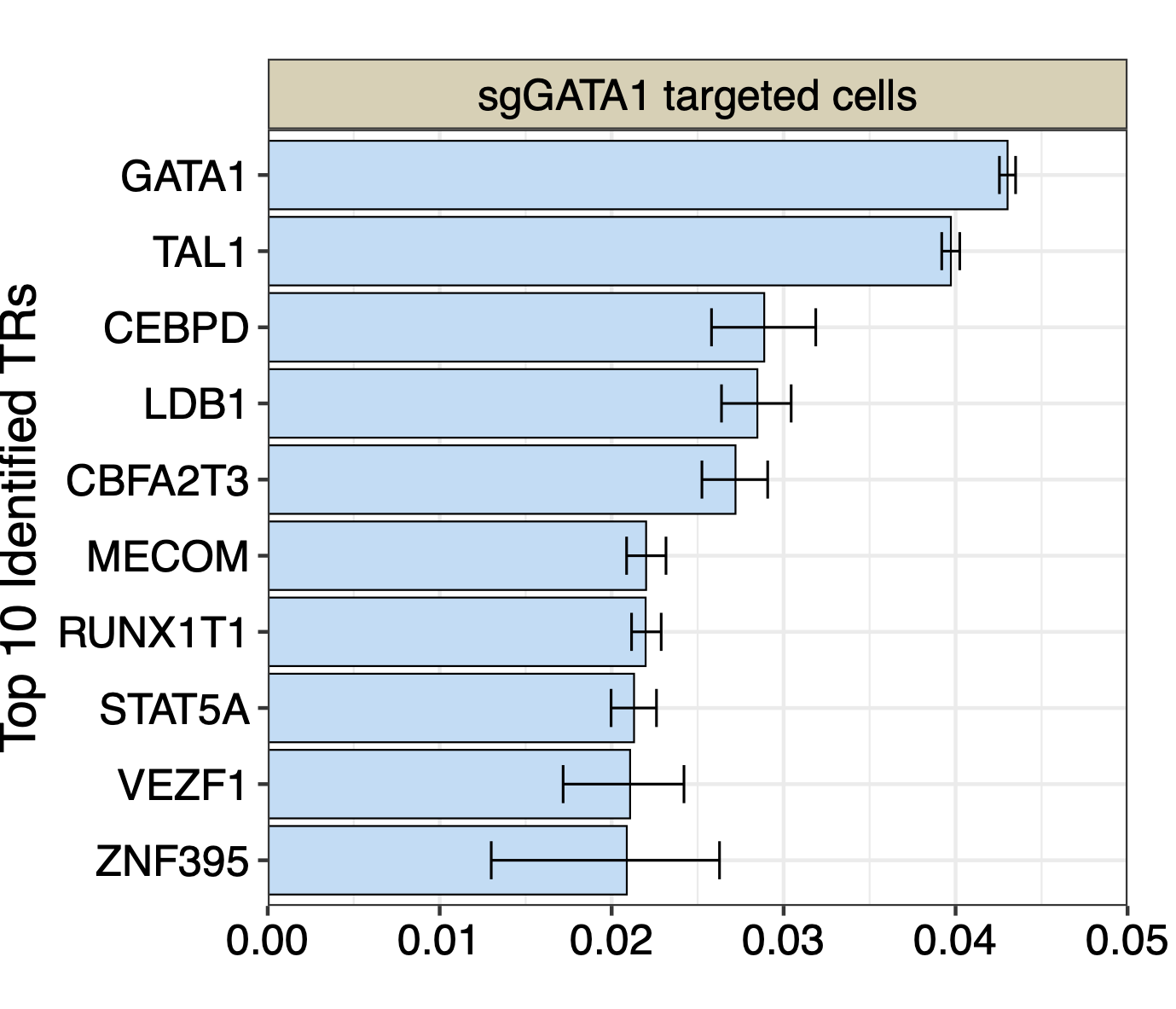
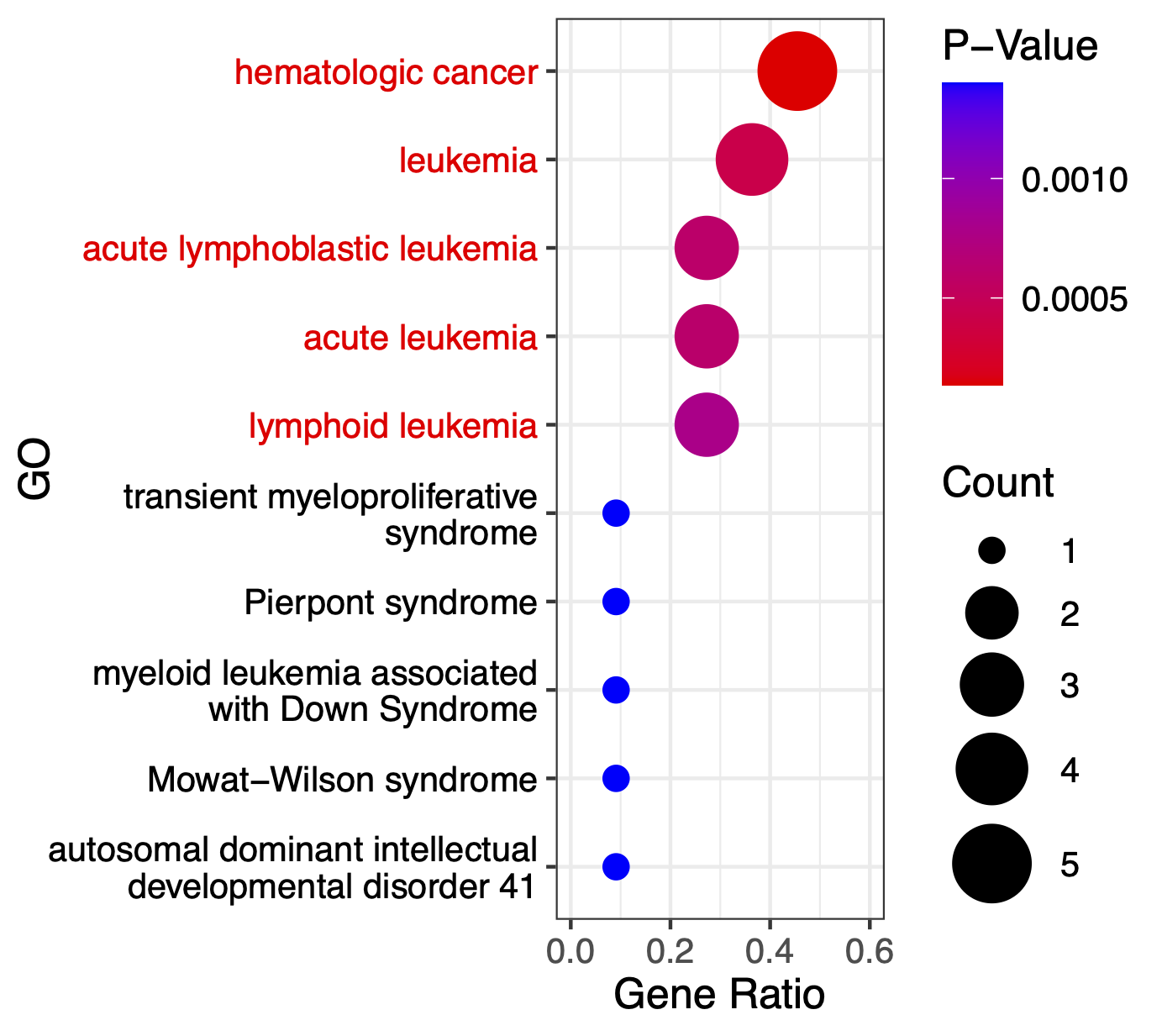
We can see BIT successfully rank GATA1 to top 1. We next conduct GO enrichment analysis using top 20 TRs identified by BIT in sgGATA1-targeted cells:
The GO enrichment analysis result plot is:
Next, we apply state-of-the-art methods to analyze the generated *.bed files and extract outputs from each method. The following tools are used:
We merged the outputs from each sgRNA-targeted-cells cluster to get the merged output table for each method.
library(stringr)
library(gridExtra)
library(dplyr)
library(tidyr)

work_dir<-"/Users/zeyulu/Desktop/Project/BIT/revision_data/K562/"

bart2_table<-read.csv(paste0(work_dir,"bart2_table.csv"))
chip_atlas_table<-read.csv(paste0(work_dir,"chip_atlas_table.csv"))
bit_table<-read.csv(paste0(work_dir,"bit_table.csv"))
icistarget_table<-read.csv(paste0(work_dir,"icistarget_table.csv"))
whichtf_files<-read.csv(paste0(work_dir,"whichtf_table.csv"))
homer_table<-read.csv(paste0(work_dir,"homer_table.csv"))

###############################################################

table_lists<-list("BIT"=bit_table,
                  "BART2"=bart2_table,
                  "ChIP-Atlas"=chip_atlas_table,
                  "HOMER"=homer_table,
                  "i-cisTarget"=icistarget_table,
                  "WhichTF"=whichtf_table)
After summarizing all tables, we proceed to generate the plots.
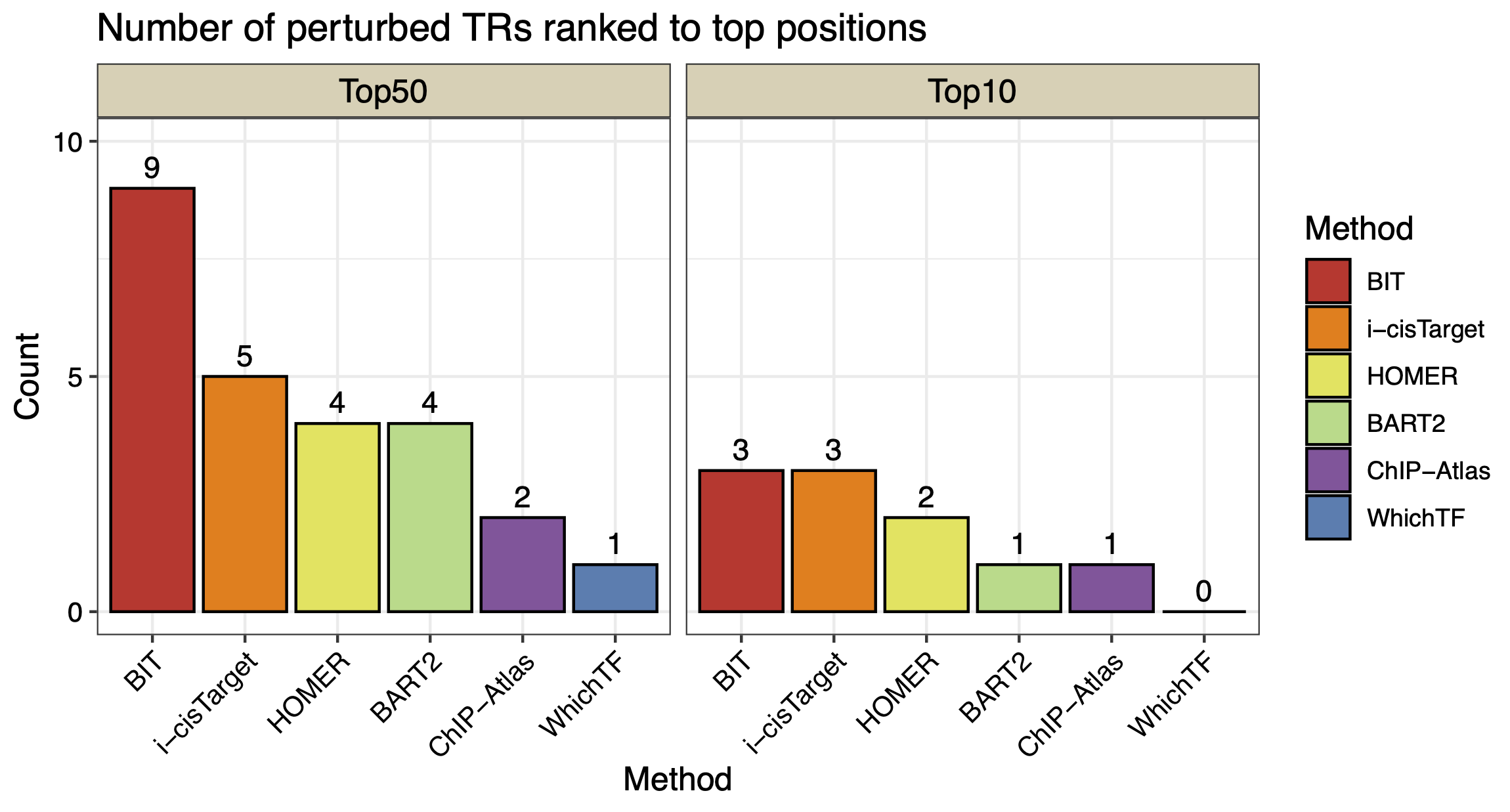
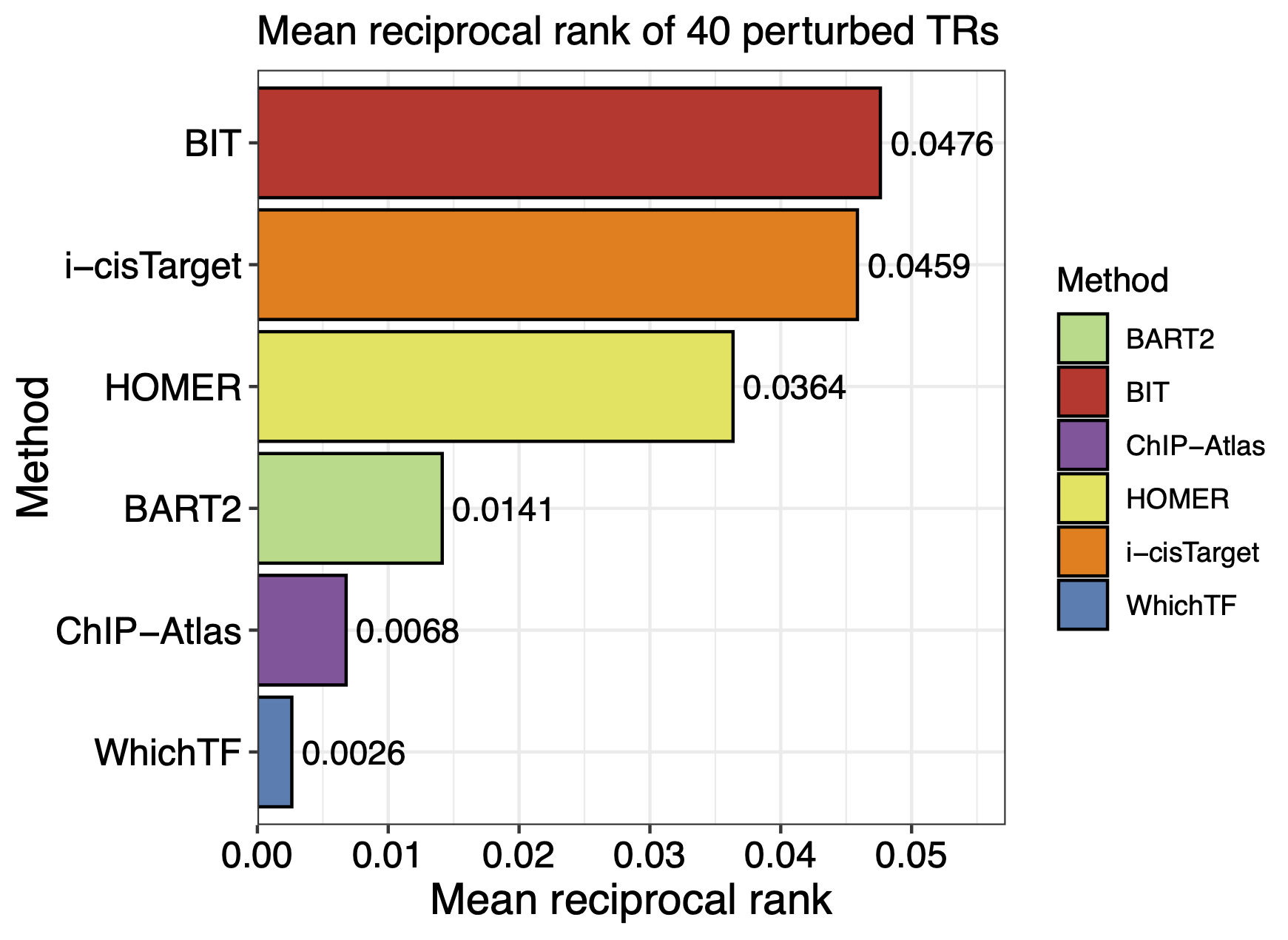
First, we calculate the Mean Reciprocal Rank (MRR) for the 40 perturbed TRs across different methods. Simultaneously, we count the number of TRs ranked within the top 10 and top 50 by each method.
##############
MRR_cal<-function(rank_res){
  rank_res<-1/rank_res
  rank_res[is.na(rank_res)]=0
  return(mean(rank_res))
}

Method_names<-names(table_lists)

MRR_res<-c()
Top50<-c()
Top10<-c()

for(i in 1:6){
  df=table_lists[[Method_names[i]]]
  rank_res<-c()
  Method_name<-Method_names[i]
  for(i in 1:ncol(df)){
    if(length(which(df[,i]==colnames(df)[i]))>0){
      rank_res<-c(rank_res,which(df[,i]==colnames(df)[i]))
    }else{
      rank_res<-c(rank_res,NA)
    }
  }
  Top10<-c(sum(rank_res<=10,na.rm=TRUE),Top10)
  Top50<-c(sum(rank_res<=50,na.rm=TRUE),Top50)
  MRR_res<-c(MRR_cal(rank_res),MRR_res)
}
names(MRR_res)<-rev(Method_names)
names(Top10)<-rev(Method_names)
names(Top50)<-rev(Method_names)

#> MRR_res
#    WhichTF i-cisTarget       HOMER  ChIP-Atlas       BART2         BIT
#0.002632788 0.045862471 0.036355700 0.006783940 0.014126888 0.047616672
#> Top10
#    WhichTF i-cisTarget       HOMER  ChIP-Atlas       BART2         BIT
#          0           3           2           1           1           3
#> Top50
#    WhichTF i-cisTarget       HOMER  ChIP-Atlas       BART2         BIT
#          1           5           4           2           4           9
Next, we visualize the MRRs for the six methods using the following plot:
MRR_df
Top_df
MRR_df<-data.frame(MRR_res)
Top_df<-data.frame(Top10)
Top_df$Top50<-Top50
MRR_df$Method<-rownames(MRR_df)
Top_df$Method<-rownames(Top_df)

ggplot(MRR_df, aes(x = reorder(Method, MRR_res), y = MRR_res, fill = Method)) +
  geom_bar(stat = "identity", color = "black", linewidth = 0.5) +  # Add border to bars
  geom_text(aes(label = round(MRR_res, 4)), hjust = -0.1, size = 4) +  # Add text labels
  coord_flip() +  # Flip coordinates for horizontal bars
  labs(x = "Method", y = "Mean reciprocal rank", title = "Mean reciprocal rank of 40 perturbed TRs") +
  theme_bw() + theme(axis.title.x = element_text(size=14,color="black"),
                     axis.title.y = element_text(size=14,color="black"),
                     axis.text.x = element_text(size=12,color="black"),
                     axis.text.y = element_text(size=12,color="black"))+
scale_fill_manual(values = c("BIT" = "#D2352C", "BART2" = "#ADDB88", "HOMER" = "#E3E457", "ChIP-Atlas" = "#8E549E","i-cisTarget"="#FA8002","WhichTF"="#497EB2")) +  # Custom colors
  scale_y_continuous(limits=c(0,0.052),expand = expansion(mult = c(0, 0.1)))  # Adjust y-axis to fit text labels
Figure:
We also visualize the number of TRs ranked within the top 10 and top 50 by each method:
Top_df_long <- Top_df %>%
  pivot_longer(cols = starts_with("Top"), names_to = "Group", values_to = "Value")

Top_df_long$Method<-factor(Top_df_long$Method,levels=c("BIT","i-cisTarget","HOMER","BART2","ChIP-Atlas","WhichTF"))
Top_df_long$Group<-factor(Top_df_long$Group,levels=c("Top50","Top10"))

ggplot(Top_df_long, aes(x = Method, y = Value, fill = Method)) +
geom_bar(stat = "identity", position = position_dodge(),color="black") +
facet_wrap(~ Group, ncol = 2) +  # Separate into two groups (Top10 and Top50)
labs(title = "Number of perturbed TRs ranked to top positions",
     x = "Method",
     y = "Count",
     fill = "Method") + geom_text(aes(label = Value), hjust = 0.5,vjust=-0.5, size = 4) +
theme_bw() + scale_y_continuous(breaks = c(0,10,5),limits=c(0,10))+ scale_fill_manual(values = c("BIT" = "#D2352C", "BART2" = "#ADDB88", "HOMER" = "#E3E457", "ChIP-Atlas" = "#8E549E","i-cisTarget"= "#FA8002","WhichTF"="#497EB2")) +  # Custom colors
theme(axis.text.x = element_text(size=10,angle = 45, hjust = 1,color="black"), axis.title.y = element_text(size=12,color="black"),
      axis.title.x = element_text(size=12,color="black"),
      axis.text.y = element_text(size=10,color="black"), title=element_text(size=12,color="black"),strip.background = element_rect(fill="#DBD1B6"),
      strip.text = element_text(size=12, colour="black"))  # Rotate x-axis labels for better readability
Figure: